Way Up Careers helps professionals move forward with expert resume writing, LinkedIn profile optimization, career coaching, and job placement support — trusted across the US and Europe to turn career goals into real offers.
LinkedIn has more than 1.3 billion members across 200 countries and regions worldwide, yet only a small share post regularly, comment meaningfully, or clearly explain what they do. That gap is your opportunity to stand out.
When you build a personal brand on LinkedIn, recruiters, hiring managers, and clients can find and trust you before you apply or pitch. This guide gives you a clear 2026 system for positioning, profile, content, engagement, and measurement.
What Is a Personal Brand on LinkedIn and Why Does It Matter?
A personal brand on LinkedIn is the professional reputation people form from your profile, posts, comments, and recommendations. It matters because recruiters, buyers, and AI search tools use those signals to judge whether you are credible, relevant, and worth contacting before any conversation starts.
Search engines and AI assistants can treat your name as an entity. More your headline, posts, and mentions point to one area of expertise, the clearer that entity becomes. Logic is similar to topical authority and E-E-A-T, applied to a person instead of a website.
Buyers respond to expertise they can see. In the 2025 Edelman and LinkedIn B2B Thought Leadership Impact Report, 64% of target decision-makers said they spend more than an hour a week consuming thought leadership, and 79% said they are more likely to champion a vendor that consistently publishes quality thought leadership.
That research is about company content, but the same pattern applies to individuals: people hire and buy from experts they already know. Repetition helps too. Psychologists call it the mere exposure effect: people tend to trust what they see often.
How Do You Define Your Personal Brand Before You Post?
Define your brand with one positioning statement that names who you help, what outcome you deliver, and the proof behind it. Write it before touching your profile, because every headline, post, and comment should repeat the same message and reinforce the same expertise.
Use this formula: I help [audience] achieve [outcome] using [method], backed by [proof].
Job seeker: I help hospital systems cut patient wait times using Lean process design, backed by eight years leading clinical operations.
Consultant: I help SaaS teams lower acquisition costs through content and SEO, backed by 40 B2B growth programs.
Narrow beats broad. “Data analytics for SaaS companies” is easier to remember, and to rank for, than “data professional.”
How Do You Optimize Your LinkedIn Profile for Search and Recruiters?
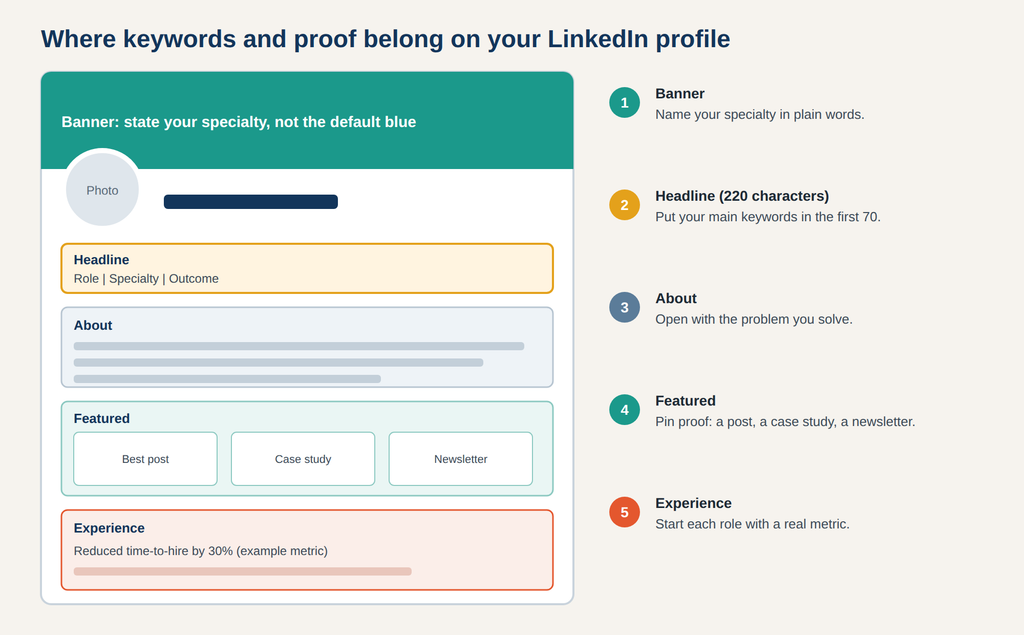
Optimize five elements: a keyword-led headline, a clear banner, a first-person About section, a curated Featured section, and metric-driven experience entries. LinkedIn works as a search engine, so place the exact job titles and skills recruiters type into the search bar in your headline, About section, and roles.
Write a Headline That Names Your Value
Replace a bare job title with this structure: Role | Specialty | Outcome. LinkedIn allows 220 characters, so use them. In search results and comments, only the first 60 to 70 characters usually show, so put your most important keywords at the start. Skip buzzwords like “guru” or “ninja.”
Job seeker: Operations Manager | Supply Chain and Logistics | Cut delivery costs 18% across 40 sites
Executive: VP of Finance | M&A Integration | Helping PE-backed firms scale past $200M
Consultant: B2B Marketing Consultant | Demand Generation | Lower CAC for SaaS teams
Complete the Rest of Your Profile
Photo and banner: a recent, well-lit headshot and a banner that states your specialty, not the default blue.
About: open with the problem you solve, add two proof points, and end with a contact method. Write in first person.
Featured: pin your best post, a case study, and your newsletter.
Experience: start each role with a metric, such as “reduced time-to-hire by 30%.”
Custom URL: claim linkedin.com/in/yourname.
Want a recruiter’s view of your profile? WayUp Careers offers LinkedIn profile optimization services built on search keywords and measurable achievements.
What Should You Post to Build Authority on LinkedIn?
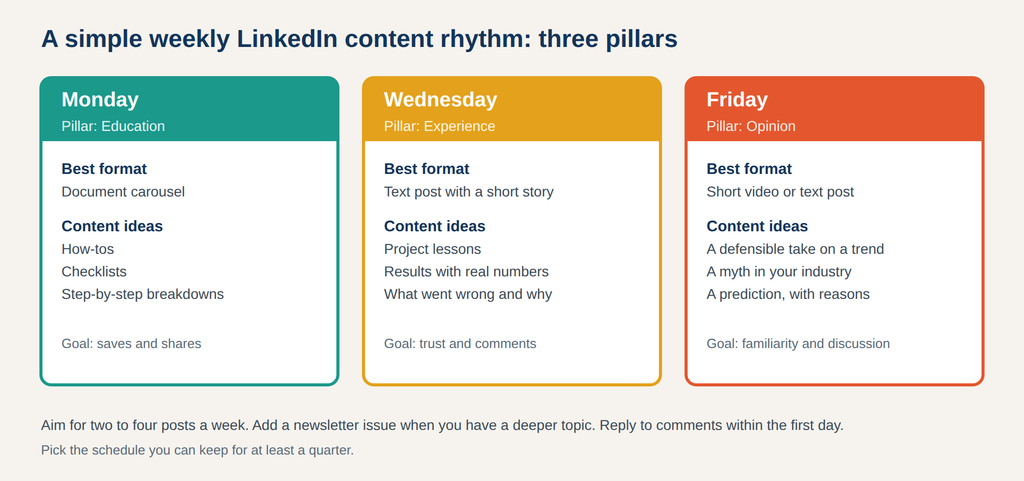
Post content that proves expertise: practical lessons, project breakdowns, original frameworks, and clear opinions. Aim for two to four posts per week around three fixed pillars, because topical consistency teaches LinkedIn and your audience what to associate with your name and expertise.
Build three pillars. Education covers how-tos and checklists. Experience covers project lessons and results, including failures. Opinion takes a defensible stand on an industry trend. A simple rhythm: education on Monday, experience on Wednesday, opinion on Friday.
Which Post Formats Work Best in 2026?
Document carousels, text posts, short videos, and newsletters each serve a different goal. Carousels often earn saves and longer dwell time, text posts tend to spark comments, video builds familiarity, and newsletters give readers a notification with every issue, independent of the feed.
Your first two lines decide whether people tap “see more,” so lead with a number, a bold claim, or a short story. Avoid engagement bait such as “Comment YES if you agree,” which can hurt your reach.
How Do You Grow Your Network Without Sounding Salesy?
Comment on relevant posts, reply to every comment on yours, and send personalized connection requests that reference shared context.
Engagement builds reciprocity, so decision-makers recognize your name before you ever message them, and warm conversations tend to convert better than cold pitches.
Use this weekly routine:
Spend 15 minutes a day adding real insight to five relevant posts.
Reply to every comment on your own posts.
Send three personalized connection requests that mention shared context.
Review your profile views, search appearances, and post impressions in LinkedIn analytics once a month.
Skip bots and mass-comment tools. LinkedIn’s User Agreement prohibits unauthorized automation, and generic comments damage credibility. Never pitch in a first message, and never share confidential client or employer details.
How Long Does It Take, and How Do You Measure Results?
Many professionals notice early signals, such as more profile views and inbound messages, within 60 to 90 days of consistent posting and engagement. Stronger authority often takes six to twelve months. Results vary by industry, audience, and effort, so judge progress on trends rather than single posts.
Use the 3C Brand Check monthly. Score each item from 1 to 5:
Clarity: can a stranger say who you help within five seconds?
Credibility: do you show metrics, recommendations, and proof?
Consistency: did you post and engage every week this month?
A total below 9 means fix your profile first. A score of 9 to 12 means consistency. At 13 or more, scale content and outreach.
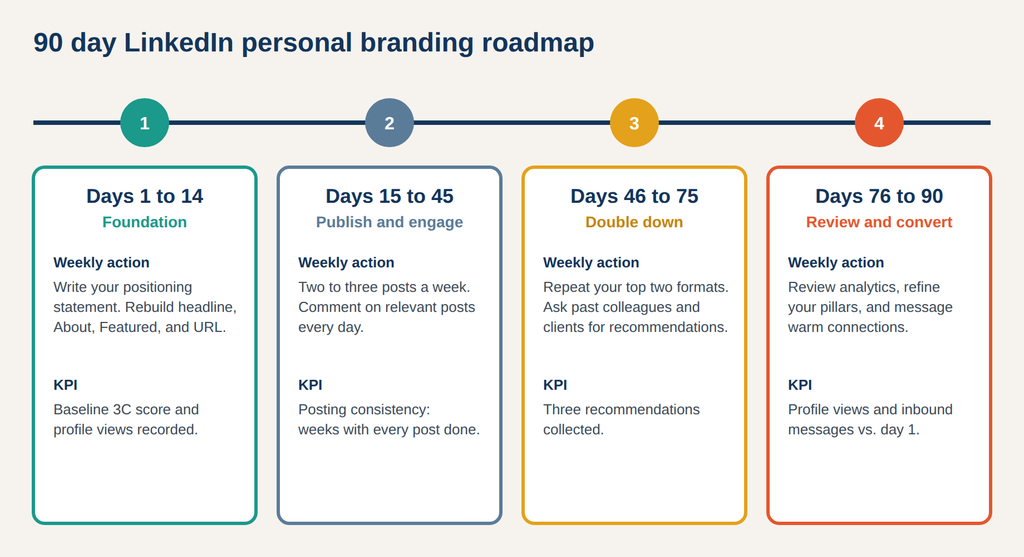
Follow this 90 day roadmap:
Days 1 to 14: write your positioning statement, then rebuild headline, About, Featured, and URL.
Days 15 to 45: publish two to three posts weekly and comment daily.
Days 46 to 75: double down on your top two formats and collect three recommendations.
Days 76 to 90: review analytics, refine pillars, and message warm connections.
What Are the Most Common LinkedIn Personal Branding Mistakes?
The most common mistakes are a vague headline, inconsistent posting, generic comments, hard selling in direct messages, and ignoring analytics. Each one weakens trust signals and keeps your profile invisible to the right audience, so fix them before you add more content.
Is It Worth Building a Personal Brand on LinkedIn?
Yes, building a personal brand on LinkedIn is worthwhile for most professionals. A strong profile helps you attract recruiters, build credibility, connect with potential clients, and create new career opportunities. It is especially valuable for job seekers, executives, consultants, and founders who want to stand out in competitive industries.
Results take time. Improving your profile and professional positioning can make an immediate difference in how people perceive you, while consistent engagement, valuable content, and demonstrated expertise help build trust over the following months.
If you need help getting started, WayUp Careers offers personal branding support through LinkedIn profile optimization, professional positioning, and outreach strategies tailored to your career goals. Start with a free LinkedIn audit to identify opportunities to improve your profile and make a stronger first impression.
Build a Stronger Personal Brand on LinkedIn
Make a stronger first impression on recruiters and potential clients with a LinkedIn profile that highlights your expertise and career goals.
WayUp Careers can help refine your profile, strengthen your professional positioning, and identify opportunities to improve your online presence. Start with a free LinkedIn audit.
How do I build a personal brand on LinkedIn from scratch?
Start with a one-sentence positioning statement, then rebuild your headline, About section, and Featured section around it so every element repeats the same message. Post two to three times weekly on three content pillars and spend 15 minutes daily commenting on relevant posts. Review your analytics after 90 days and refine.
How often should I post on LinkedIn for personal branding?
Post two to four times per week, because that cadence keeps you visible without sacrificing quality, and consistency matters more than volume. Choose a schedule you can maintain for at least a quarter, then adjust based on which formats earn comments, saves, and profile views.
Can job seekers use personal branding on LinkedIn to get interviews?
Yes. Job seekers who pair a keyword-rich profile with weekly engagement are easier for recruiters to find and easier to trust, which can lift inbound messages and interview requests. Start with your headline, a metric-driven experience section, and three recommendations before you worry about posting.


 By dinwajeeh
October 12, 2026